Ball of Ages
- 4.4
- Rating
- 10.00K
- Installs
- Free
- Price

 Analysis by App-foxy
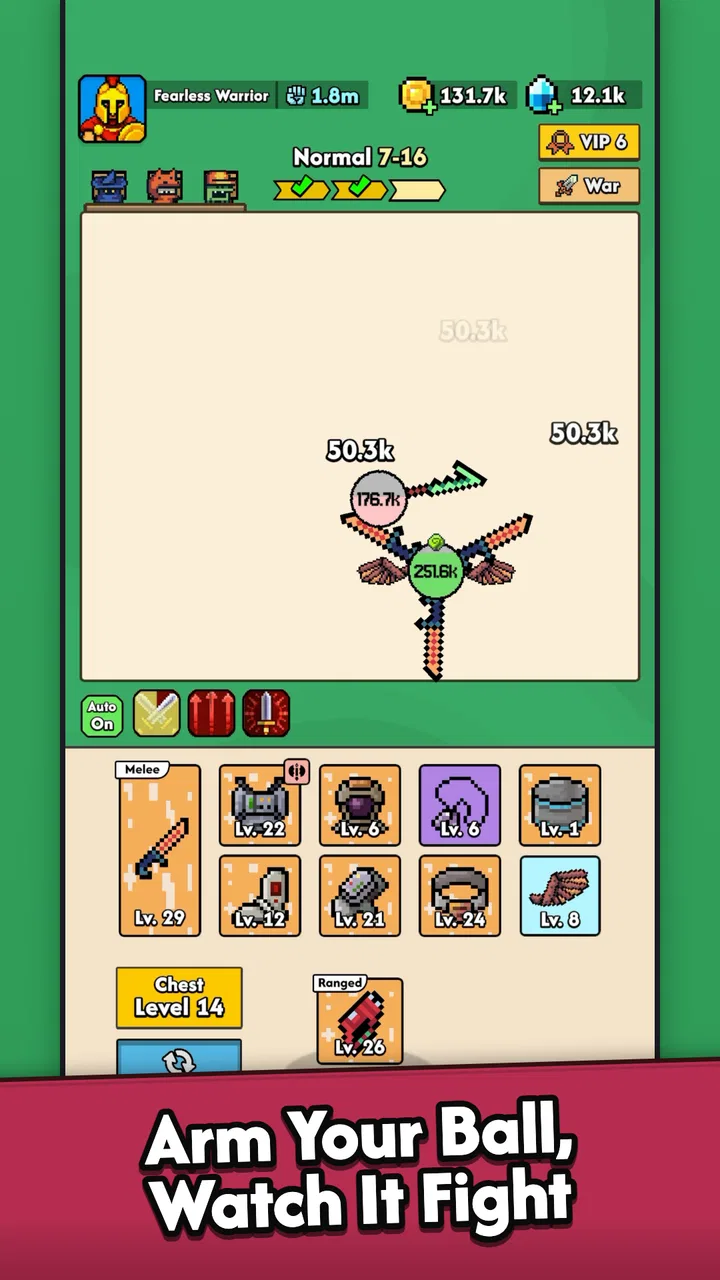
Ball of Ages is a role-playing game built around a very simple promise: keep progressing, keep collecting, and turn that progress into more power. I found the appeal easy to understand within a short session. It is the kind of game I can open when I have a few spare minutes, make a handful of decisions, and leave feeling that something has moved forward.
That simplicity is both its greatest strength and its main limitation. Ball of Ages is not trying to replace a large, story-heavy role-playing adventure with a huge world, complex dialogue, or a long list of systems to master. Instead, it focuses on the satisfying loop suggested by its name: gather rewards, improve your position, and continue pushing ahead. For players who enjoy gradual growth without a demanding learning curve, that can be a comfortable fit.
It is free to play and suitable for Everyone, with support for devices running Android 6.0 or later. Rollic Games is the developer, and the game has reached over ten thousand installs with a 4.4 average from roughly one hundred fifty ratings. Those figures suggest a small but positive audience rather than a crowded blockbuster, which is useful context: I would approach it as a focused casual RPG, not as a major online destination.
You May Also Like

 AccuWeather: Weather Radar
AccuWeather Review: A Quick, Clear Forecast for Everyday Decisions
For everyday plans, the best forecast is the one you can understand quickly. AccuWeather makes rain timing, radar, and local conditions easy to act on, with a few trade-offs.

 Hill Climb Racing
Why Hill Climb Racing Still Turns Crashes Into One More Run
A tiny car, a bumpy hill and one more upgrade: Hill Climb Racing keeps resurfacing because its simple chaos makes every near-miss feel personal.

 AliExpress - Shopping App
AliExpress Makes Global Shopping Feel Personal, but Shoppers Bear the Risk
AliExpress turns a global marketplace into a pocket-sized discovery engine. Its reach is useful, its shopping loop compelling, and its trade-offs easy to miss.

 Lords Mobile: Kingdom Wars
Lords Mobile Is a Kingdom-Building Routine, Not a Quick Match
A case-by-case verdict on the building, battles, device demands, and social commitments that make Lords Mobile rewarding for some players and exhausting for others.

 PDF Scanner app - TapScanner
TapScanner Makes Paperwork Easier to Capture, Check, and Share
TapScanner makes scanning with a phone feel less like a rescue operation and more like a dependable step in getting work done. Its capture tools are useful, though not flawless.

 Block Blast!
 Shows How Much a Puzzle Game Can Leave Out
A quiet grid game shows why puzzle players increasingly value instant clarity, repeatable skill and low-pressure play—and where the genre still needs to catch up.
More From Our News Desk
View All News


Where the interesting decisions begin
The first thing I pay attention to in a progression game is whether I am actually making choices or merely tapping through rewards. Ball of Ages works best when I treat each improvement as part of a plan rather than spending every gain immediately. The temptation is always to choose the most obvious upgrade as soon as it appears, but a stronger short-term boost is not automatically the best long-term move.
That creates a modest but meaningful decision space. When progress slows, I have to think about whether the answer is more immediate power, better preparation for the next obstacle, or simply continuing to accumulate until an upgrade becomes worthwhile. The game does not need a complicated skill tree to create this tension. Even a small number of choices can matter when resources arrive gradually and every purchase changes the pace of the next few minutes.
I especially like this structure for short sessions. If I am waiting for an appointment, taking a break from work, or relaxing before bed, I do not want to spend the first ten minutes remembering a complicated control scheme. The central loop is approachable, and I can return after a gap without needing to reconstruct an elaborate story or a large inventory.
At the same time, players who want constant tactical variety may find the decision space narrow. Ball of Ages is more about managing momentum than mastering a deep combat system. If your favorite mobile RPGs are built around positioning, party composition, detailed equipment comparisons, or active ability timing, this game may feel intentionally lightweight.
Planning a session instead of tapping on autopilot
My most useful approach is to give each session a small purpose. I might play specifically to reach the next meaningful improvement, test whether a new power increase changes my pace, or save progress toward a larger threshold. That simple habit makes the game feel less like an endless stream of disconnected rewards.
It also helps to separate “progress I can claim now” from “progress that will improve the next stretch.” A reward that looks attractive immediately may have less value if it leaves me unable to handle the next slowdown. Conversely, saving everything can make a session feel dull. The practical balance is to spend enough to keep momentum while preserving a clear target for the next upgrade.
This is one of the game’s quieter strengths: it gives a casual player room to form a routine. I do not need a spreadsheet, but I do benefit from noticing which choices actually change my pace. That observation turns a basic progression loop into something slightly more deliberate.
How the reward loop affects risk and reward
Endless progression games live or die by the feeling that effort leads somewhere. Ball of Ages generally understands that expectation. The prospect of another reward or another increase in power gives ordinary actions a reason to continue, especially when I am close to a new milestone.
The risk is that repetition can become visible once the novelty fades. If the same actions keep producing similar outcomes, the reward loop may start to feel like maintenance rather than discovery. I noticed that the experience is strongest when I set a concrete near-term objective. Without one, it is easier to open the game out of habit and close it again without feeling especially engaged.
That makes the game a better companion for intermittent play than for long, uninterrupted marathons. A short session can feel productive because the next reward is close. A much longer session may expose the limits of the loop, particularly for players who need frequent changes in scenery or mechanics.
There is also a financial trade-off to consider. The game is free to download, but in-app purchases range from $1.99 to $99.99 per item. I would not treat the presence of purchases as a reason to avoid it automatically, yet I would recommend deciding on a personal spending boundary before getting deeply invested in progression. The most expensive option is not automatically the sensible option, and casual enjoyment should not turn into pressure to buy simply because progress feels slower at a particular point.
For me, the healthiest way to play is to judge purchases by convenience rather than necessity. If spending only removes waiting or adds a temporary boost, I ask whether that actually improves the part of the game I enjoy. If the answer is no, continuing without paying is the better choice. This keeps the central loop meaningful instead of turning every obstacle into a sales prompt in my mind.
What to do when progress slows
A slowdown is not always a sign that I need to spend money. It can be a useful point to reassess how I have been using rewards. I look at whether I have been choosing upgrades for immediate satisfaction, whether I have ignored a more efficient path, and whether I am expecting a short session to produce a major leap.
One practical technique is to stop chasing every small improvement. I save toward a change that clearly affects the next stage of progress, then use the resulting increase to rebuild momentum. This requires patience, but it gives the session a shape and prevents me from scattering resources across upgrades that barely alter the experience.
Another useful habit is to play in deliberate bursts. I make progress until I reach a natural stopping point, then return later rather than forcing the game through a slow stretch. That approach is particularly suitable for Ball of Ages because its casual structure does not demand that I remain connected for a long period.
Adapting to the game’s lighter style
Ball of Ages rewards adaptation, although not in the same way as a traditional party-based RPG. I am not constantly rebuilding a team or reacting to a large collection of enemy types. Instead, I adapt my expectations, spending rhythm, and session length to the pace of the progression loop.
That distinction matters when comparing it with usual alternatives in the role-playing category. A conventional mobile RPG may offer more visible variety through characters, equipment, quests, and battles, but it can also demand more attention. Ball of Ages is easier to pick up and put down. I spend less time managing a virtual life and more time following a single, understandable path toward greater power.
On the other hand, a deeper RPG usually gives me more ways to recover from a mistake. If one character build fails, I can change equipment or alter my party. In a more focused progression game, poor choices may be felt mainly as slower advancement. That is not necessarily harsh, but it means I should avoid making purchases or upgrades impulsively when I am unsure of their value.
The game is also a better alternative to heavier RPGs for people who dislike narrative interruptions. I can enjoy the feeling of development without committing to a long campaign or remembering a large cast of characters. If story is the reason you play role-playing games, however, the lighter structure may leave you wanting more context and emotional investment.
A realistic everyday use case
Imagine having a ten-minute break between errands. A large RPG may be inconvenient because you need to travel to a location, complete a battle, manage rewards, and stop at a safe point. Ball of Ages fits that gap more naturally. I can open it, check what progress is available, make one or two considered upgrades, and close it without feeling that I abandoned a major quest.
The same applies to a short commute when I am not driving, or to the end of a busy day when I want something interactive but not mentally demanding. The game’s value is not that it overwhelms me with content; it is that it gives a small, self-contained sense of advancement.
There is a trade-off in that convenience. A game designed for quick progress checks may not provide enough texture for a dedicated evening. I would choose it for the spaces between larger activities, not as my only role-playing game.
Who will enjoy it, and who should skip it
I would recommend Ball of Ages to players who like incremental power, uncomplicated sessions, and the satisfaction of watching a small investment improve the next part of a run. It is also a reasonable choice for someone who wants a free entry point into casual role-playing games without immediately learning a large collection of systems.
I would be more cautious recommending it to players who need a strong story, extensive customization, competitive depth, or a constant stream of new mechanics. Those players are likely to get more from a traditional RPG with a richer combat model or a more substantial campaign.
It may also be a poor fit if you dislike in-app purchase structures on principle. Even when I choose not to buy anything, knowing that optional items can range up to $99.99 changes how I evaluate the progression curve. Players who prefer a single upfront purchase or a completely purchase-free experience may feel more comfortable elsewhere.
How the game develops over time
The long-term question is whether the feeling of growth remains satisfying after the first impression. Ball of Ages has a clear advantage here: its core idea is easy to understand, so returning does not require much mental effort. That makes it dependable as a background game, especially when I want a familiar routine.
Its depth comes less from learning a large ruleset and more from refining how I approach progress. I become better at identifying worthwhile goals, resisting wasteful spending, and recognizing when a session has reached a natural pause. That is genuine depth, but it is a particular kind of depth. It rewards planning over experimentation and consistency over dramatic tactical reversals.
The current version is 1.7.0, and the game was released on April 15, 2026. Those details place it in a relatively early stage of its life compared with long-established mobile RPGs. I would keep expectations realistic about the size of its ecosystem and choose it for the experience available now, not for assumptions about future additions.
Device compatibility is fairly broad for an older Android baseline, since it runs on Android 6.0 and later. That makes it accessible to people using hardware that may not handle the newest, visually demanding RPGs comfortably. Still, the practical experience can vary with device performance, so I would avoid treating broad system support as a guarantee that every phone will feel equally smooth.
Small habits that improve the experience
First, I recommend setting a stopping point before beginning a session. A target such as the next worthwhile improvement gives the reward loop direction and reduces aimless tapping.
Second, I would avoid spending simply because a purchase appears at the moment progress slows. I wait long enough to decide whether I am facing a temporary plateau or a genuine change in the game’s pace. This is especially important in a free game with optional purchases across a wide price range.
Third, I treat each return as a chance to compare outcomes. Did the last upgrade noticeably improve progress? Did saving resources make the next session more productive? These questions are simple, but they reveal whether I am playing strategically or just following the most visible button.
Finally, I keep it alongside a deeper RPG rather than expecting it to serve every role. Ball of Ages is strongest when I want a low-pressure progression break. A more elaborate alternative is better when I want a story, a demanding battle, or a sense of exploration.
My verdict on the strategy behind Ball of Ages
Ball of Ages succeeds because it stays focused. Its role-playing identity is built around the pleasure of collecting, improving, and continuing, rather than around a large number of interconnected systems. I appreciate that clarity. The game is easy to understand, convenient for short sessions, and capable of giving ordinary spare time a small sense of purpose.
Its limitations are just as clear. The lighter decision space will not satisfy everyone, and repetition can become noticeable if I play for too long without a specific goal. The purchase range also means I would approach progression with a budget in mind, particularly if I am sensitive to optional spending.
My recommendation is therefore conditional but positive. If you want a casual RPG that fits around your day and gives you a steady path toward more power, Ball of Ages is worth trying for free. If you want a rich campaign, complex combat, or deep character building, I would choose a more traditional role-playing game instead.
For the right player, the best part is not any single reward. It is the small planning rhythm: decide what matters, accept a slower stretch, make a meaningful improvement, and return when you have time. That balance between immediate progress and patient saving is where the game has more substance than its simple presentation first suggests. I would keep it installed as a compact progression game, provided I remember that its appeal lies in steady momentum rather than endless variety.
FAQs for Ball of Ages
01What is the main objective of Ball of Ages?
Ball of Ages is a physics-based puzzle game where the objective is to guide a ball through various obstacles to reach the end goal. Each level presents unique challenges and requires strategic thinking to overcome hurdles and solve puzzles using the game's realistic physics engine.
02Is Ball of Ages free to download and play?
Yes, Ball of Ages is free to download on both Android and iOS platforms. However, the game may include in-app purchases for additional levels, power-ups, or cosmetic items. Players can enjoy the basic game without spending money, but optional purchases can enhance the experience.
03What are the system requirements for Ball of Ages?
Ball of Ages is designed to run smoothly on most Android and iOS devices. For optimal performance, it's recommended to use a device with at least 2GB of RAM and a recent operating system version. This ensures the game’s graphics and physics engine function without lag or crashes.
04Does Ball of Ages offer multiplayer or social features?
Currently, Ball of Ages focuses on a single-player experience. However, it offers social features such as leaderboards and achievements, allowing players to compete with friends and global players. Future updates may include direct multiplayer modes or additional social interactions.
05Are there any parental controls in Ball of Ages?
Ball of Ages includes parental controls to restrict in-app purchases and manage playtime. Parents can set up these controls through the device's settings, ensuring a safe gaming environment for children. The game itself is family-friendly, with no inappropriate content.
Pros
- Engaging and challenging gameplay.
- Stunning graphics and animations.
- Intuitive controls for easy play.
- Regular updates with new levels.
- Multiplayer mode enhances fun.
Cons
- Occasional in-game ads can distract.
- Requires constant internet connection.
- Some levels feel repetitive.
- In-app purchases can be pricey.
- Battery drain on older devices.

Ball of Ages
Gallery